

The Country of the Blind
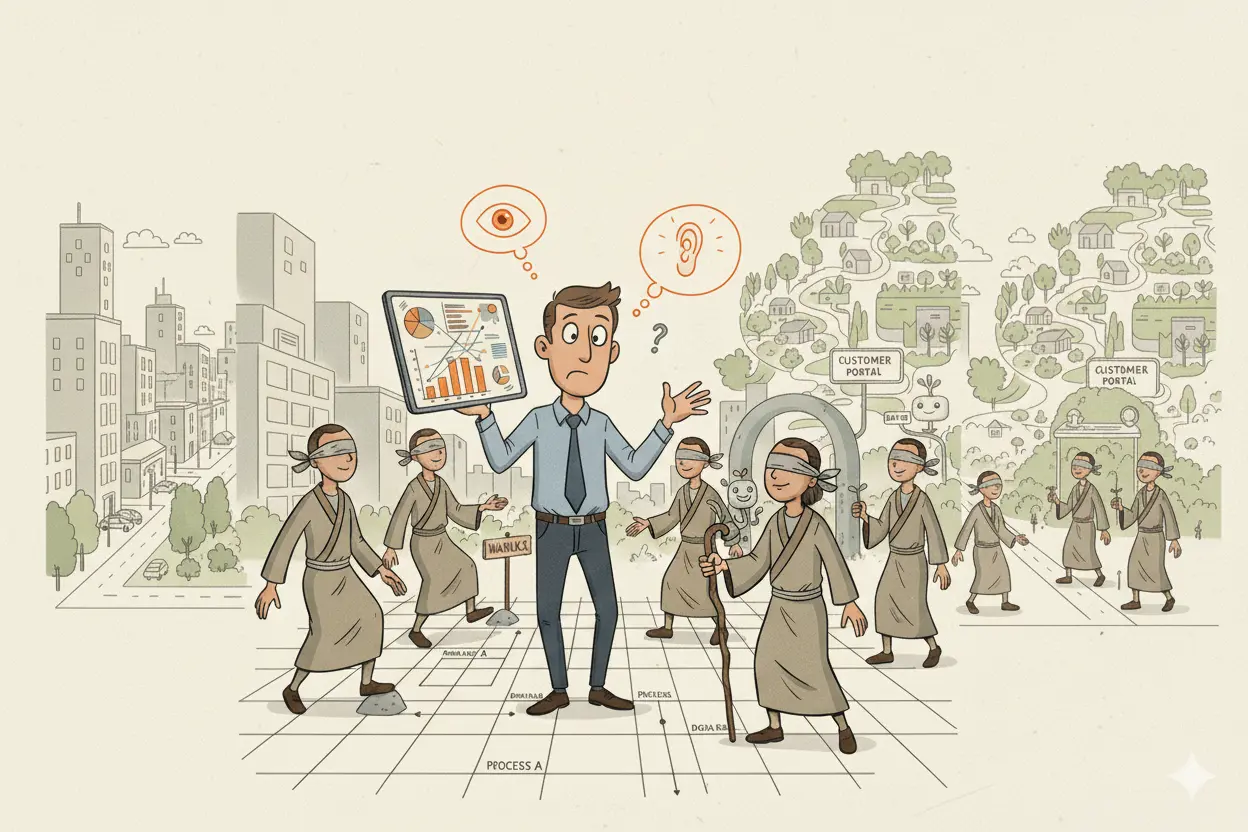
In 1904, Wells published a story about a mountaineer named Nunez who falls into a hidden valley where everyone is blind. He arrives convinced his sight will make him powerful. It doesn’t.
The blind community has built a perfectly functional world. They farm, build, and live according to a sensory logic that doesn’t rely on vision. Their system works. Not despite their blindness, but because they’ve adapted to it.
When Nunez tries to explain “sight”, they dismiss it as nonsense. His eyes and his talk about colors and light sound like confusion. His advantage becomes irrelevant. Even disruptive.
In the country of the blind, the one-eyed man isn’t king. He’s an outsider who doesn’t understand how the system truly works.
The Business Parallel
That story has stayed with me, especially when thinking about customer experience.
So often, teams believe they “see it all.” They have data, dashboards, customer journeys, and projections. They know every step of the process and assume the customer should move the same way. Rationally. Predictably. Efficiently.
But customers live in another kind of world. Partial, improvised, emotional. They find shortcuts, build habits, and make decisions that look irrational from the business side. Yet those decisions make perfect sense from theirs.
Their “blindness” is often adaptation. It’s how they’ve optimized reality with the tools they have.
And that’s where the arrogance of the sighted shows up.
We think we’re helping, clarifying, or teaching. Sometimes we’re just forcing people to see through our eyes.
What I’ve Learned
The real insight is the opposite: to see less and listen more.
To step into the customer’s world without assuming superiority. To ask simple questions and see how things truly work when no one’s explaining them.
Because in the country of the blind, vision alone doesn’t make you king. Humility does.
The best customer experiences I’ve seen don’t come from companies that “know better.” They come from companies that pay attention. That notice what customers are already doing and build around that reality instead of fighting it.
They stop designing for the world they think exists and start designing for the world that does.
If you want to read the story. The full text of H. G. Wells’s “The Country of the Blind” is in the public domain and available for free reading at multiple digital libraries, including Project Gutenberg.
I write about strategy, creativity, and how we shape ideas in the digital age. Visit faguilera.com or check out my work on Upwork.