


It’s Easter weekend. In Chile and across Latin America, Semana Santa is still marked on the calendar, but the feeling around it has shifted. Trust in the church has collapsed over the last two decades, and the fallout has been significant. Today, saying you’re a Christian in certain circles invites immediate judgment. People connect it straight to the scandals, to the cover-ups, to the worst of what the institution has done. The leap from “I believe” to “you must support all of that” happens fast.
I understand it. I really do.
But I’ve been noticing something lately. That same rejection, that same exhausted cynicism, is spreading beyond religion. People dismiss entire political groups because of their worst members. I’ve heard someone say, seriously, that they prefer AI to humans because at least AI is consistent. The overgeneralization is getting out of hand. And I think it’s making everyone more bitter and more alone.
I’ve been spending time learning about Lithuanian culture with my partner over the past couple of years. Their Easter is different. It leans pagan - painting eggs, marking the change of seasons, finishing one cycle and starting another. Rabbits, nature, ritual without dogma. I genuinely like it. This year we’re planning to enjoy those traditions with friends, some familiar faces, some new ones.
What struck me is that the traditions work even without a theological argument behind them. The gathering is the point.
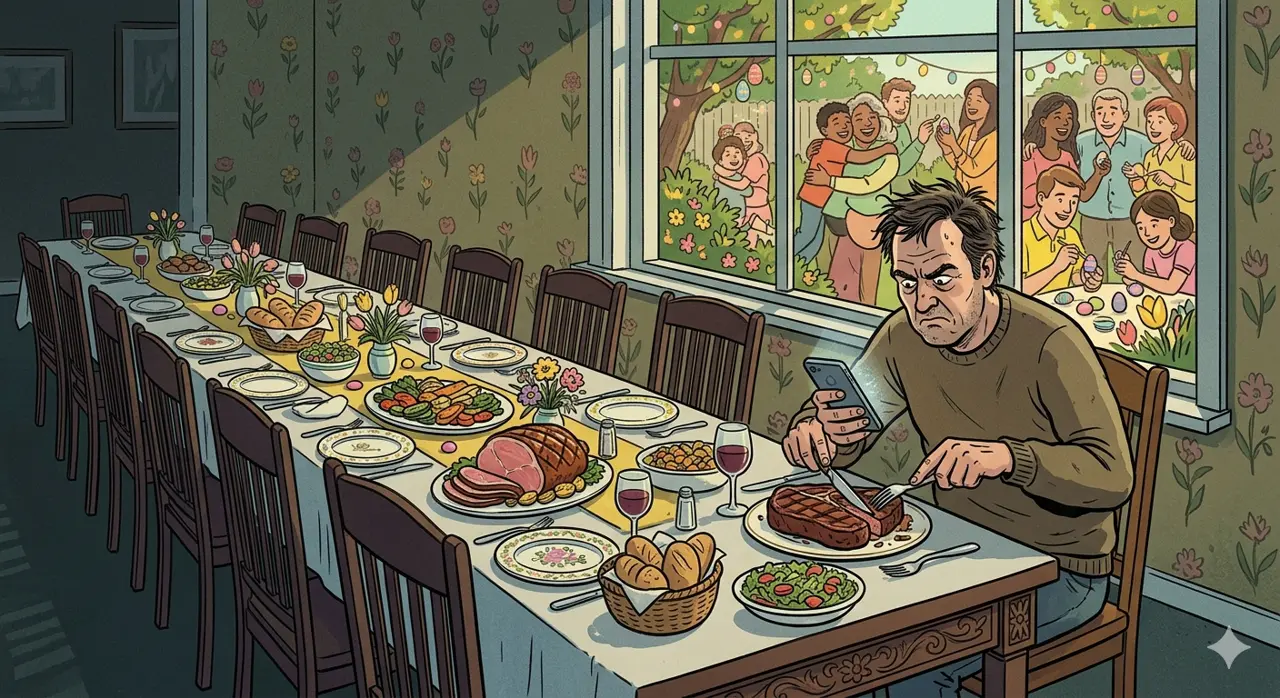
I’m agnostic. I was more religious at an earlier point in my life, but I’ve moved away from that. What I haven’t moved away from is the part I actually valued: the community. The sense that people have a reason to show up, sit together, and feel like they belong somewhere.
Every religion, every group, every tradition exists partly for that. Scientology, Buddhism, your local knitting club - there are bad actors in all of them, and good people too. Throwing out the whole thing because of the bad apples is how you end up isolated and smug. Not free.
Freedom means letting people gather around whatever works for them, as long as no one is getting hurt. If someone wants to eat steak on Good Friday because it makes them feel defiant, fine. If someone wants to fast and attend mass, also fine. Neither of them needs to perform their choice for the other.
The best rituals I’ve had recently have nothing to do with religion. Watching the Oscars with people who have opinions. Looking forward to Eurovision in May — genuinely, as a shared event that’s half spectacle, half community experiment. These are our modern versions of the same impulse. Get people in a room. Give them a common reference. Let them feel less alone for a few hours.
The institution doesn’t have to be perfect. It just has to give people a reason to show up.
We can - and should - challenge the specific bad decisions and harmful actions inside any group. That’s different from rejecting the whole concept of community because humans are imperfect. Humans are always going to be imperfect. That’s not changing.
What we can change is how quickly we write each other off.