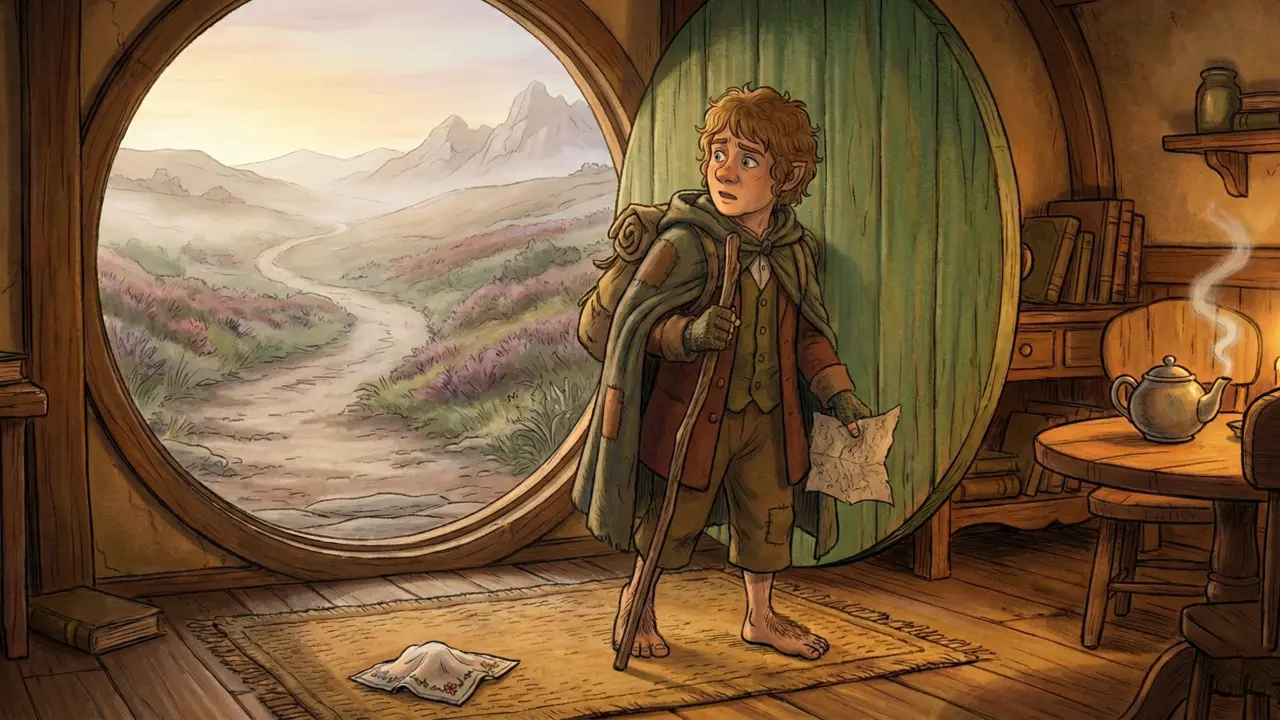



For the past few months, I’ve been retreating into the Shire.
While the digital world seems to move faster and grow noisier every day, I decided to go back to the basics. I’ve been re-reading J.R.R. Tolkien’s The Hobbit, exploring how its themes of revision and quality can apply to the modern world of UX and consulting.
In my previous articles, I looked at Tolkien’s “Patch Notes” (the idea that even masterpieces are never truly finished) and the Shire as an antidote to digital “slop.” But there is a specific moment in the story that haunts every consultant or creative: the moment Bilbo Baggins stands in his doorway, looking at a map he doesn’t understand, realizing he is completely out of his depth.
Standing in the Doorway
The tea is hot. The fire is crackling. The pantry is stocked.
If you’ve ever sat at your desk looking at a daunting new project proposal or a blank strategic document, you know exactly how Bilbo felt while the Dwarves cleaned his plates. He was a Hobbit of “respectable” standing. He had a reputation for being predictable. And yet, there was a map on his table—a map of a world he didn’t know, marked with a task he didn’t feel equipped to handle.
In my own “adventures” in consulting, I’ve spent a lot of time standing in that doorway. It’s the crushing weight of the threshold—the feeling that you aren’t ready for what comes next.
The Consultant’s Imposter Syndrome: “I am no Burglar”
In the book, Bilbo’s greatest internal hurdle wasn’t the dragon; it was the word “Burglar.” He didn’t have a degree in thievery. He didn’t have the muscle of the dwarves or the lineage of kings. He felt like a fraud.
When I’m staring down a complex design problem or a high-stakes strategy for a client, I often hear that same internal dialogue:
“Who am I to solve this? There are bigger agencies. There are people with more ‘warrior’ energy and massive teams.”
But there is a profound insight hidden in Gandalf’s choice: He didn’t want a warrior. Warriors are loud. Warriors are expensive. Warriors often get stuck in the front door because they’re carrying too much armor.
He needed someone scrappy. He needed someone small enough to move through the cracks, someone who wasn’t tied down by “the way things have always been done.” I’m beginning to realize that what we call “imposter syndrome” is often just the feeling of being lean and unburdened by corporate bloat.
The Strategy of the Scrappy (What I’m Striving For)
I don’t have this all figured out. In my consulting work, I still feel the pull of the Shire—the comfort of the familiar. However, I’m trying to reframe my “smallness” as a set of aspirational goals:
- Trading “Clanking Armor” for a Magic Ring: I often worry that not having a big agency name makes me look “unprofessional.” But I’m striving to see that as my magic ring. I don’t have the armor of corporate bureaucracy or endless committees. I want to use that silence to move faster, pivot quickly, and experiment in ways big players simply can’t.
- The Power of the “Hobbit” Question: There is a huge pressure in consulting to have all the answers immediately. But because I often feel “unqualified,” I’m forced to ask the “stupid” questions—the ones a seasoned “Warrior” might be too proud to ask. I’m finding that these first-principle questions are often where the real breakthroughs happen.
- Finding the Back Door: When you don’t have a massive budget, you have to be resourceful. I’m learning to see “scrappiness” as a creative discipline. It’s about finding the “back door” into a problem when the front gate feels impassable.
The “No Handkerchief” Moment
The most relatable part of Bilbo’s story isn’t when he finds the treasure. It’s when he realizes he’s late, leaves his house in a panic, and forgets his pocket handkerchief.
He left his comfort, his routine, and his “respectability” behind. He didn’t look like a hero; he looked like a mess.
In my work, I’m giving myself permission to be a bit of a mess at the start of a project. I’ve realized that I will probably never feel 100% “ready” for the challenges I take on. But the goal isn’t to be a perfect, confident warrior; it’s to be a brave enough burglar to run out the door anyway.
The adventure doesn’t start when you’re certain. It starts when you decide that the “uncomfortable wild” is exactly where the value is hidden—even if your tea is still on the table.