


Synopsis
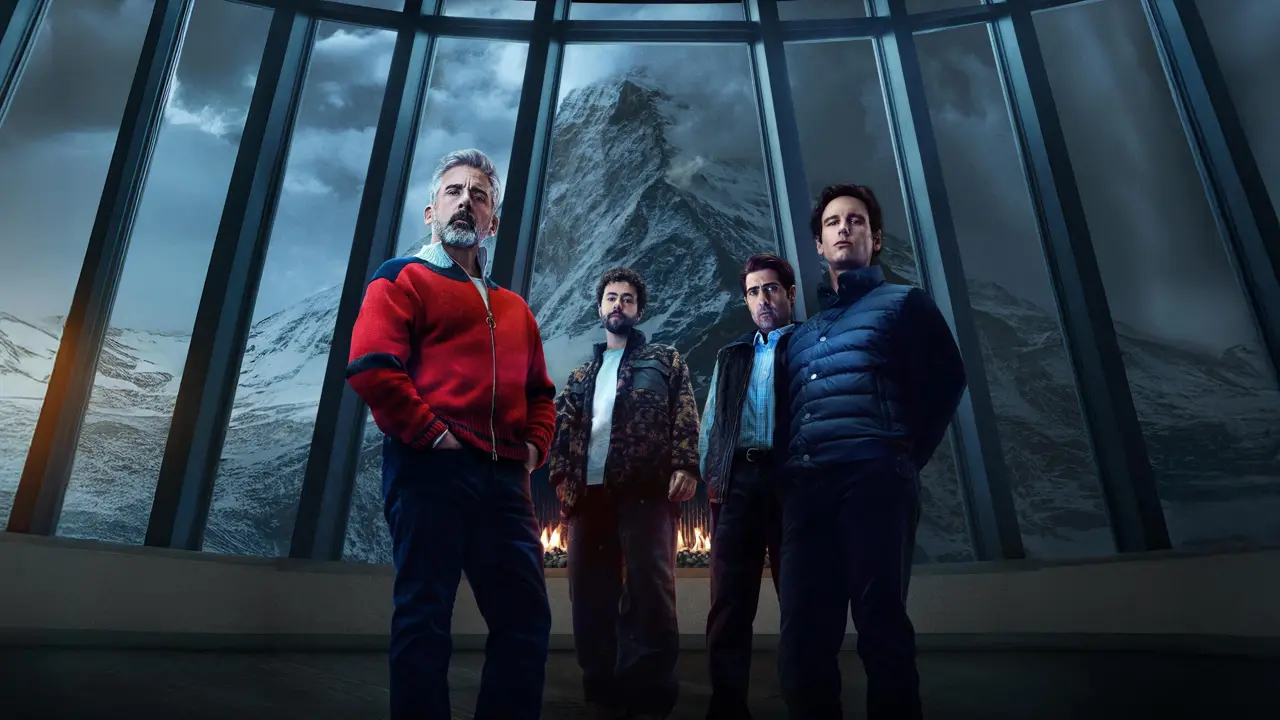
In a near-future world shaped by social media and post-truth algorithms, The Mountainhead centers on a high-stakes gathering. Hugo “Souper” Van Yalk (Jason Schwartzman) invites three fellow entrepreneurs to his isolated mountain lodge. Venis “Ven” Parish (Cory Michael Smith), a billionaire behind the dominant AI-powered platform Traam, is under pressure after deepfake riots create global unrest. Jeff Abredazi (Ramy Youssef) runs Bilter, a startup that can verify synthetic content and restore some balance to public discourse. Randall Garrett (Steve Carell), a terminally ill venture capitalist and early mentor to them all, wants the singularity - hoping that AI will outpace death.
What starts as a philosophical debate about responsibility and progress turns into a slow-burn psychological game. The men try to persuade, then pressure, Jeff to hand over his technology - framing it as saving the world, while clearly seeking power and control. Their isolation and wealth detach them from the consequences of their actions. And the more they talk, the less human they feel.
What I liked
A relevant setup: The film’s world, where AI-generated content is indistinguishable from truth, isn’t science fiction—it’s tomorrow morning’s news. Armstrong builds a convincing backdrop where deepfakes aren’t just political tools but existential threats. The film raises powerful questions about who owns the right to define reality - and whether they should.
A single setting with pressure: Most of the movie happens in one far from the world mountain house, and it works as a symbol and as a good place to develop tension. The intimacy lets us sit with each conversation, watch egos inflate, and see the shifts in alliances. The closed space adds tension, like a digital-age chamber drama.
Steve Carell’s performance: As Randall, Carell brings nuance to what could have been a caricature. His quiet desperation, driven by illness and a need to stay relevant, gives the film the only emotional performance.
Armstrong’s dialogue still cuts: At its best, the writing captures the self-serious, posturing energy of tech elites. Their tone-deafness, their need to sound visionary while masking insecurity, comes through in sharp exchanges that echo Succession.
What could be better
No emotional weight behind the ideas: The themes are solid, but the characters are hollow. Unlike Succession, where dysfunction was layered with trauma and history, these men feel invented only to deliver ideas. There’s no personal cost, no depth—just monologues that sometimes feel interesting, but others just feel silly and shallow.
A thriller that doesn’t thrill: Halfway through, the film tries to pivot toward suspense. But when everyone is already morally grey and emotionally flat, raising the stakes doesn’t work. The shift feels mechanical, not earned.
Brotherhood without history: The characters talk like they have a shared past, but we never see it. There’s no real friendship, no rupture, no story. Without that context, the betrayals and tension feel like nothing.
Too many symbols, not enough story: Everyone stands for something: power, idealism, mortality, failure. But none of them feels like a real person. The movie becomes an interesting concept, but hard to connect with.
My Insight
I was hopeful because I know what Jesse Armstrong can do. In Succession, he took the worst people imaginable and gave them moments of vulnerability, longing, and humanity. That’s what kept us watching. In The Mountainhead, he leans more into structure than emotion. The film is well-conceived, and the themes matter—but the characters don’t. I kept waiting for one of them to break out of the mold. To say something personal. To surprise me. That never came.
Still, the film isn’t irrelevant. It reflects how unprepared our institutions are to handle the speed of technological disruption. The future will be shaped by private debates like the one this film stages—among people with unchecked power, vague ethics, and no sense of public accountability. That’s a chilling thought. And maybe the coldness of this film is intentional. But as a viewer, makes it more of a shallow proposition than an interesting drama.
🌟Rating: 4/10
Brilliant theme lost in detached execution. Important questions, but no one real to develop them.
For Discussion
Is it enough for a film to be intellectually smart if it doesn’t connect emotionally? The Mountainhead reflects a growing anxiety around AI and the monopolies shaping it. But if we don’t care about the people having the conversation, does the critique land? Maybe this is part of the problem—the people with power are so removed, even fiction can’t humanize them.
Related series or movies
- The Social Network (2010) – David Fincher. A cold but focused portrait of the birth of Facebook and how ego shaped an empire.
- Ex Machina (2015) – Alex Garland. A contained, philosophical thriller about creation, control, and deception through AI.
- Her (2013) – Spike Jonze. An emotional exploration of artificial intimacy, loneliness, and how tech reshapes connection.
- Devs (2020) – Alex Garland. A slow, atmospheric series about determinism, quantum tech, and the cost of control.
- Don’t Look Up (2021) – Adam McKay. A chaotic but timely satire about systemic failure and elite disconnection in the face of global crisis.
- Black Mirror: Hated in the Nation (2016) – Charlie Brooker. An AI-driven narrative about public outrage, media manipulation, and digital punishment.
- The Menu (2022) – Mark Mylod. A critique of class and entitlement through a dark, single-location ensemble story.
- Triangle of Sadness (2022) – Ruben Östlund. A brutal and absurd satire on wealth, power, and collapse.
Technical Details
-
Release Date: May 31, 2025
-
Director & Writer: Jesse Armstrong
-
Main Cast:
- Steve Carell as Randall Garrett
- Cory Michael Smith as Venis “Ven” Parish
- Ramy Youssef as Jeff Abredazi
- Jason Schwartzman as Hugo “Souper” Van Yalk
-
Runtime: 1h 49min
-
Genre: Satirical Drama / Tech Thriller
-
Rating: TV-MA
-
Distributor: HBO Films
-
Where to Watch: Streaming on Max
Trailer
If you enjoyed this review, I’d love to hear your thoughts. Especially if you work in creative fields or have experienced the chaos behind making things happen.
I offer consulting for creators, brands, and small businesses focused on communication, digital presence, and brand clarity. You can explore more of my work at faguilera.com, or connect with me through Upwork if you’re looking to collaborate.